‘New draft impact report for Tendele Coal Mine is misleading’ - SABC News - Breaking news, special reports, world, business, sport coverage of all South African current events. Africa’s news leader.
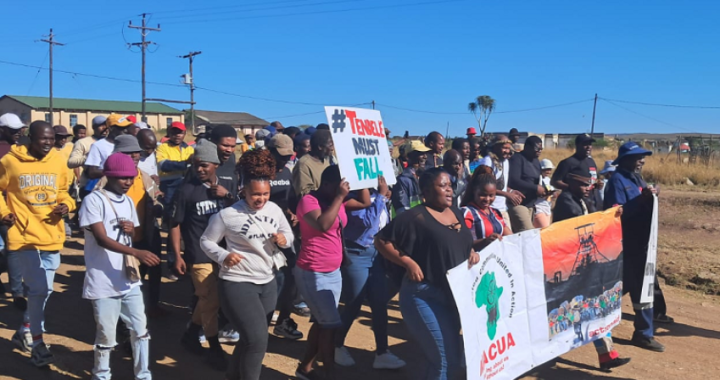
Community, environmentalists say new draft EIA for Tendele coal mine is biased, misleading.
When you drive from Mfolozi to Mtubatuba, you can smell the sadness
While the climate impacts of burning coal are well documented, a lesser-told story is the misery endured by communities forced to accommodate new coal mines as neighbours. Banks which finance these mines are complicit.
COAL VS COMMUNITIES: Tendele Coal Mining sends in the bulldozers in rural KZN before crucial high court interdict ruling
Residents allege Tendele is acting unlawfully and appears to be breaching the spirit of previous undertakings to hold off on any ‘mining or related activities’ until a court case has been resolved.
COAL VS COMMUNITIES: KZN rural residents beg high court to save their homes and livelihoods and rein in rampant Tendele coal mining
‘Tendele acts as if it can do anything it wants in our community … It is as if our lives do not matter. We are merely dots on a map to be told, and not asked.’ — Israel Nkosi, resident of the Emalahleni area in rural KwaZulu-Natal.
‘Those who witnessed the (grave exhumation) process said that it was horrifying. Some saw semi-decomposed bodies removed, while others reported diggers plunging pickaxes into the graves and returning with bones stuck on the picks. One resident said that he saw the skull of his loved one attached to the end of the pickaxe.’ — Dr Garret Barnwell.
DUST, BONES, DYNAMITE AND DISPOSSESSION: Expert report uncovers ‘hidden mental trauma’ of opencast coal mining in rural KwaZulu-Natal
’Those who witnessed the (grave exhumation) process said that it was horrifying. Some saw semi-decomposed bodies removed, while others reported diggers plunging pickaxes into the graves and returning with bones stuck on the picks. One resident said that he saw the skull of his loved one attached to…
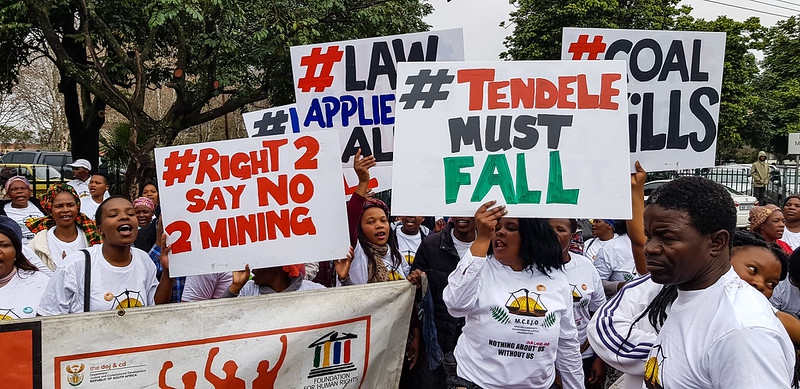
In an extraordinary show of public solidarity for ALL RISE, 38 civil society organisations have come out in support of an earnest call on the National Union of Mineworkers; Mpukunyoni Traditional Authority; Mpukunyoni Community Mining Forum; the Association of Mineworkers and Construction Union to and their representative attorney to:
• Respect Pretoria high court Judge Noluntu Bam’s 4 May ruling that Tendele Coal Mining’s 2013 application for a mining right (to expand its Somkhele operations) failed to comply with the law; and that the decision of officials in the Dept. of Minerals and Energy to award that right was invalid; • Respect the right of the Mpukunyoni people to assert their constitutional rights without fear of reprisal; and • Respect the right of their attorneys (ALL RISE) to act without fear of harassment, intimidation and defamation.
* Amongst the most serious transgressions was Tendele’s “fundamental breach of the law with regard to public participation”.
The 38 organisations’ letter follows a 17 May 2022 statement titled “Mpukunyoni Community calls on All Rise and their funders to account to the community for their efforts to close Tendele Mine” which attacks All Rise, demanding to know the source of its funding, accusing it of wanting to close the mine and stating that All Rise’s actions are “tantamount to a gross human rights violation”.
Note: ALL RISE Attorneys represent the Mfolozi Community Environmental Justice Organisation, the Global Environmental Trust, Mining Affected Communities United in Action, ActionAid, and the Southern Africa Human Rights Defenders Network.
All Rise is truly humbled by the support and thanks every single organisation that signed this letter. An attack on one is an attack on all.
SIGNED BY: Amnesty International South Africa
Bench Marks Foundation
Socio-Economic Rights Institute of South Africa (SERI)
Centre for Applied Legal Studies
Centre for Environmental Rights
Earthlife Africa
Mining Affected Communities United in Action (MACUA) and Women Affected by Mining United in Action (WAMUA)
Just Share
KZN Violence Monitor
Lawyers for Human Rights
Southern Africa Human Rights Defenders Network (SouthernDefenders)
ActionAid South Africa
Global Witness
Helen Suzman Foundation
Africa Coal Network
Environmental Defender Law Center
Global Environmental Trust
groundWork
350Africa.org
Natural Justice
Health Justice Initiative
BirdLife South Africa
P.E.A.C.E. Foundation Trust
EarthLore Foundation
EMS Foundation
Ian Player Magqubu Ntombela Foundation Trust
Living Limpopo
Animal Law Reform South Africa
Beauty Without Cruelty South Africa
Love Africa Marketing
Rhinos in Africa
Wilderness Leadership School
Future 4 Wildlife
Vervet Monkey Foundation
Global White Lion Protection Trust
Centre for Animal Rehabilitation and Education
The Wildlife and Environment Society of South Africa (WESSA)
Judgment in the long-standing matter of MCEJO and Others v Minister of Minerals and Energy and Others was handed down on the evening of 4 May 2022.
In her well-reasoned 48-page judgment Judge Bam finds in favour of the Applicants by rejecting all of Tendele’s arguments and declaring Tendele’s mining right invalid. The Minister’s decision in dismissing the appeal against the grant of the Mining Right and the approval of the Environmental Management Programme is also declared invalid and set aside. The Applicants, the Mfolozi Community Environmental Justice Organisation (MCEJO), the Global Environmental Trust, MACUA, SAHRDN and ActionAid SA, are elated by the victory.
By way of background, in May 2016 Tendele was granted a mining right of 212 km2 to significantly expand its Somkhele opencast coal mine, located in northern KwaZulu-Natal, subject to approval of an Environmental Management Programme (EMP). Tendele’s EMP, prepared as part of a Scoping and Environmental Impact Assessment (EIA) under the Mineral and Petroleum Resources Development Act (MPRDA) was approved several months later in October 2016. The applicants appealed to the Minister of Minerals and Energy in August 2017 against the Department of Mineral Resources’ (DMR) decision to grant it. The Minister subsequently dismissed MCEJO’s appeal in June 2018. In November 2018 the applicants brought an application in the Pretoria High Court to review and set aside the 2016 Mining Right, the approval of the EMP and the Minister’s appeal decision in Tendele’s favour.
The Court determined three main issues, namely: i) the defective Scoping and EIA; (ii) the ground based on the Interim Protection of Informal Land Rights Act (IPILRA); and (iii) defects in public participation [para 24] Judge Bam states in her no-holds barred judgment that “the wheels came off” during the scoping phase “when the regional manager of DMR, KwaZulu-Natal (RM), allowed Tendele’s consultants, GCS, to dictate to him how Tendele intended to carry out the exercise that would lead to the Scoping Report instead of insisting on compliance with the law” [para 14] She further states that “[i]ndeed the record shows that the RM accepted Tendele’s Scoping Report, even though it had been compiled without consultation with interested and affected parties and without providing proof of the information shared during the consultation, which was clearly in violation of the law”. [1]
Judge Bam provides detailed interpretation of the law around scoping and EIA and refers to Tendele’s view that the scoping phase required no public participation as “a fundamental breach of the law with regard to public participation”. She further states that “Tendele’s attempts to justify their exclusion of groups … was nothing short of egregious”. The Scoping/EIA failed to meet the demands of legislation. She states that “[t]he attitude displayed by Tendele during the scoping phase of it’s application process is offensive. It portrays Tendele as an ‘unbridled horse’ that showed little or no regard for the law” [2]
A large portion of the judgment deals with the applicants’ accusation of Tendele riding roughshod on the rights of the community in that the applicants’ members were neither consulted nor did they consent to the deprivation of their communal rights to the land in terms of IPILRA. 3 [para 39] The Court refers to Tendele’s ‘disturbing’ defence that ‘since the grant of a mining right does not extinguish the right of a landowner or any other occupier of the land in question; the question of compensation does not arise”. [3] According to Tendele’s interpretation of IPILRA the requirements of compensation and section 2(4) (community consent) are only triggered when the deprivation is caused by a disposal of land. [4]
Judge Bam finds that “Tendele’s interpretation appears to lose sight of the fact that it is interference with the use, enjoyment or exploitation or diminution to the occupation or ownership that brings about compensation. For this reason, how the deprivation arises should not water down the compensation element provided for in IPILRA. Tendele’s interpretation epitomizes the ‘blinkered peering at an isolated provision in a statute’ that the court warns against in Scribante as opposed to reading the statute purposively… Tendele’s’ interpretation waters down, if not renders nugatory, the protection offered by IPILRA to shield the informal rights holders. Such interpretation cannot be allowed”. [5]
Tendele’s second defence that it obtained consent from the Inkosi, is also shot down in flames by Judge Bam. The referenced consultations with iziNdunas who provided consent by way of a Resolution of the Traditional Authority “says nothing more that the [traditional authority] granted consent to Tendele. There is no evidence to support that the applicants were lawfully deprived of their informal rights in terms of IPILRA. There is no evidence of invitation to the community and its representatives, no agenda, no minutes, no evidence of who was present. The Resolution on its own does not meet the requirements of IPILRA”. [6]
Judge Bam’s final reason why Tendele’s defence must fail is centered around the fact that a decision to grant consent to a mine “has far reaching consequence in so far as the mining operations ability to interfere with the occupiers’ and landowners’ rights.” [7]With reference to the court in The Ingonyama Trust and Advancement of the South African Constitution and Others v The Ingonyama Trust and Others, Judge quotes:
“Consent must be given freely, without duress or deception, and with sufficient legal competence to give it….Consent must be properly sought and freely given, and the person whose consent is required must have full and reliable information relating to the scope and impact of the subject matter, and must have the choice to give or withhold his or her consent.”
“In all, Tendele did not obtain consent as envisaged in section 2 of IPILRA and the applicants ground therefore succeeds”.[8]
The appeal is therefore remitted back to the Minister for reconsideration in accordance with the findings of the judgment. [9]
In summary, the findings and the effects thereof are:
The Scoping/EIA was unlawful. Prior to the Minister making a decision on the Appeal, a valid Scoping/EIA must be conducted.
There was no consent in terms of IPILRA. Prior to the Minister making a decision on the Appeal, informed consent must be obtained from the majority of those whose land rights will be affected by the mining operation.
The public participation process was defective. Prior to the Minister making a decision on the Appeal, a full public participation process must be conducted, and such process must comply with the requirements of the Public Participation Guidelines in terms of the National Environmental Management Act, 1998 and Chapter 6 of the Environmental Impact Assessment Regulations, 2014.
Costs were awarded to the applicants, including the costs of two counsel for this application and the Rule 7 application which was brought by Tendele in December 2020 and withdrawn at the 11th hour in March 2021.
“Tendele is the author of its own misfortune. “Had DMR and Tendele complied with the law back in 2013 when this mining application process began, none of this would have been necessary. The Court has made it clear that the people of the land must be seen, must be heard, and must be consulted when their rights are going to be so fundamentally affected. The fact that the DMR and Tendele ignored the law and the people for so long is the reason that the applicants were forced to bring this application. It has been a long road but finally they have won.” Kirsten Youens, attorney for the Applicants.
The applicants wish to thank Legal Aid SA for its assistance in this matter.
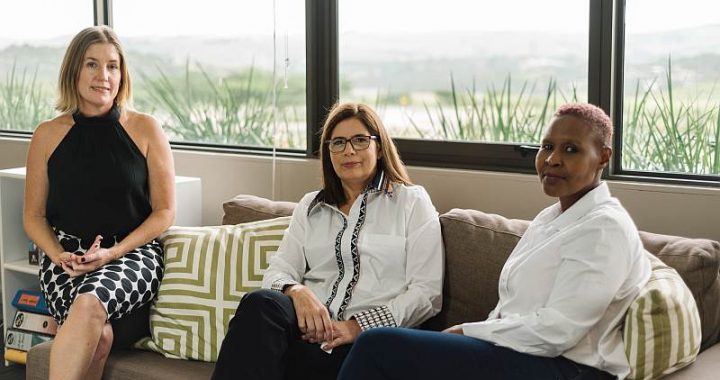
Kirsten Youens, Janice Tooley and Lihle Mbokazi – photo by Casey Pratt
2021 has been a challenging year for ALL RISE and our clients as we have continued to navigate the Covid-19 pandemic on top of all the usual challenges faced in the public interest law space.
With our small but dedicated team we are very proud of all we have accomplished this year and take this opportunity to thank all those who support us and our clients in working towards environmental and climate justice.
Reflecting on 2021, we would like to share our highlights, struggles and direction for next year.
Strategic litigation on behalf of mining-affected communities
Our main focus has again been strategic litigation against Tendele Coal Mining (Pty) Ltd which we initiated on behalf of MCEJO and GET, firstly in 2017, in an application for an interim interdict, and secondly, in 2018, in a review application of the mine’s 2016 mining right to significantly expand its current open cast coal operations.
In respect of the first case, the interim interdict,we filed an application on 8 April for leave to appeal to the Constitutional Court (“Constitutional Court Appeal”) againstthe majority judgment of the Supreme Court of Appeal requiring the Constitutional Court to provide finality on whether environmental authorisation is required for mining activities applied for and authorised under the MPRDA before December 2014. We also seek the Constitutional Court’s correction of the High Court’s costs order and the chilling effect it will likely have on public interest litigation. We hope to be allocated a court date in the second quarter of 2022. We would like to extend our gratitude to Advocates Tembeka Ngcukaitobi SC and Mawande Mazibuko for all their hard work on this case.
In one of its many attempts to halt the court case, Tendele filed a second Rule 7 application in December 2020 disputing Youens Attorneys’ mandate, which it withdrew only after a challenge was brought by a group of six suspended MCEJO members in early February of this year asking the Court to declare Youens’ mandate terminated and to have the review application withdrawn.
Notably, the hearing of the main application in March was scuppered to make way for this spurious challenge by the MCEJO splinter group which was rightfully dismissed. At the same time, ALL RISE successfully applied to the court to grant four new applicants permission to intervene and join the proceedings, and in doing so, gained four new clients -the Global Environmental Trust (GET), Mining Affected Communities United in Action (MACUA), the Southern Africa Human Rights Defenders Network (SAHRDN) and ActionAid South Africa, all of which have a long association with the members of MCEJO in the Somkhele community supporting them in their fight against the environmental and social injustices.
The matter was complicated further when Tendele supplemented its papers in March essentially conceding that the mining right was invalidly granted and undertaking to abandon all but 17.66 km2 of the original 212km2 . Nonetheless it sought to retain the three mining areas of Ophondweni, Emalahleni and Mahujini which it said are necessary to save the mine from closure. Tendele also wanted the court to order that these three areas go back to the Minister to reconsider the original administrative appeal, this time with the numerous additional studies Tendele completed in late 2019 and early 2020 and any comments that interested and affected parties may submit.
However, the Applicants argued that in addition to the flaws associated with the original EIA studies and public participation process, the size of the retained three mining areas of Ophondweni, Emalahleni and Mahujini are 45% larger than initially assessed. This is particularly so for Mahujini which is now five times its original size. The approximately 27 new studies conducted in 2019 and 2020 are also flawed for varying reasons and the overwhelming majority having been undertaken without any public participation. Thus, any consultation as part of a second round of the appeal would be insufficient. The more appropriate remedy is for the mining right be set aside and the process to begin afresh to identify and address the impacts and community concerns properly. The other issue in dispute is the lack of free, prior and informed consent in terms of the Interim Protection of Informal Land Rights Act, 1996 (IPILRA), and its effect on the original granting of the Mining Right.
Judgment was reserved after the application was heard in November and we anxiously await the outcome. We are extremely grateful to our Advocates Anna-Marie de Vos SC and Louise Ferreira for the long hours they put in settling the papers and arguing on behalf of the Applicants.
We also joined as co-applicants in a second urgent application for an interdict against SHELL and IMPACT AFRICA joining Sustaining the Wild Coast (SWC), together with the Dwesa-Cwebe Communal Property Association, fishermen – Ntsindiso Nongcavu (Port St Johns), Sazise Maxwell Pekayo and Cameron Thorpe (Kei Mouth) – Amadiba traditional leader and healer Mashona Wetu Dlamini in applying for an urgent interdict against Shell’s seismic survey off the Wild Coast. The matter was heard on 17 December and judgment has been reserved. In this matter, we are represented by another strong legal team consisting of the Legal Resource Centre, Richard Spoor Inc. Attorneys as well as Advocates Tembeka Ngcukaitobi SC and Emma Webber.
Administrative action
Litigation is lengthy and costly and it is not the panacea to all fights against injustice. As our courts have held, it is a last resort and internal remedies should first be pursued. These include appeals against various licences that have been issued to companies despite extreme adverse impacts, inadequate mitigation and lack of consultation with affected parties.
We have spent a large part of 2021 participating in appeal processes:
ALL RISE is representing MCEJO and GET in appealing Tendele’s water use licence for 142 water uses related to its existing and new mining operations. The appeal was filed on 3 November 2021 and suspends the licence unless the Minister directs otherwise. Among the numerous grounds of appeal, are lack of landowner consent, lack of consultation with the local residents, in particular the rural subsistence farmers in the area who rely on water to sustain their land-based livelihoods and numerous shortcomings in the technical report on which the decision to grant the licence was made.
ALL RISE is also representing MCEJO and GET in an appeal filed on 7 December against the decision granting Tendele a waste management licence for the disposal of slurry and mine discard into the KwaQubuka pit. The grounds for the appeal include incorrect listed activities having been applied for and authorised and an EIA that fell short of the technical, reporting and consultation requirements prescribed by the EIA Regulations, 2014, the National norms and Standards for the Disposal of Waste to Landfill and the Planning and Management of Residue Stockpiles and Residue Deposits, 2015.
ALL RISE also submitted an appeal on behalf of GET, of the environmental authorisation granted to Zululand Anthracite Colliery, also operating in northern KwaZulu-Natal (not far from Tendele’s Somkhele mine) to expand its operations and open a new adit to access additional underground coal resources. The adit is directly adjacent to Masokaneni village and yet the residents have not been adequately consulted. ALL RISE has also assisted community members in submitting their own appeals.
Community Support
Being parties to litigation in a community torn apart by mining is not easy for our clients to say the least. Lihle Mbokazi, ALL RISE’s liaison manager is in constant communication with MCEJO members and assists them in getting legal support from ALL RISE and security support from SAHRDN and Frontline Defenders when necessary.
Trauma counselling is provided to people who have been victimised and intimidated as well as to those who have suffered loss as a result of living in a mining affected community.
We believe in frequent contact with our clients to keep them updated and reassured and in addition to one-one-one contact we were able to hold eleven community meetings with MCEJO during the year.
Defending the defenders
More than a year on, we mourn the death of Mam’FikileNtshangase, one of our incredibly courageous and outspoken members of MCEJO who was brutally murdered for her opposition to the mine, especially as those responsible have not been apprehended. In this regard, we are in regular communication with the police service and continue to explore options with Mary de Haas (violence monitor for KZN) and other public interest groups in the call for justice for Mam’Fikile as well as to prevent further violence against other defenders.
This year, in honour of Mam’Fikile, and on the anniversary of her death, ALL RISE, in collaboration with Global Witness, held an international webinar to raise awareness of the risks of Environmental Defenders faceaptly titled “Defending the Defenders”.
The event was facilitated by Simphiwe Sidu, Regional Legal Advisor of Southern African Human Rights Defenders Network with a formidable line up of speakers:
Kirsten Youens, Chief Executive Director of ALL RISE
Mary Lawlor – United Nations Special Rapporteur on the situation of human rights defenders. Founder of Frontline Defenders
Rowan Williamson – Inspire Dialogue Foundation Trustee, the former Archbishop of Canterbury, and retired master of Magdalene College, Cambridge University
Arnold Tsunga – Chairperson of Southern Africa Human Rights Defenders Network. Country director for National Democratic Institute in Zimbabwe.
Mary de Haas – Interventionist human rights worker and violence monitor in KwaZulu-Natal, South Africa.
Louis Wilson – Senior Communications Advisor, Global Witness
The webinar was attended by 95 people from around the world and the feedback from the participants was very encouraging. We hope to have more of these webinars in 2022.
Holding funders accountable
On behalf of its clients, ALL RISE has very recently written to Nedbank asking it to explain why it has funded and continues to fund Petmin’s and Tendele’s Somkhele open cast mine when this project does not comply with Nedbank’s own environmental and social policy or the various international standards to which the bank subscribes. In particular, this is in respect to involuntary resettlement and significant environmental pollution and degradation which severely impacts on local communities and their livelihoods, and erodes their resilience to climate change. We have also asked Nedbank to reassess this project in light of our submissions. We await Nedbank’s response.
Education, Training, and Empowerment
Part of our vision is to share knowledge and make law accessible to people in their mother tongue so that access to justice can be truly realised. To this end we organised two very successful workshops and are in the process of preparing training material that are the beginnings of exciting things to come:
EIA guide in isiZulu and Training Manual for Environmental Assessment Practitioners
A two-day workshop was held with 40 residents from four rural communities, mostly MCEJO members in March 2021 at which participatory training was provided in isiZulu on Environmental Impact Assessment (EIA). The interactions and feedback provided at the workshop are being used to develop a guide to EIA in isiZulu as well as a training programme (methodology and material) on EIA, both of which will be made freely available to environmental consultants, NGOs and communities.
Land rights and mining-related impacts
A two-day workshop in isiZulu was held in August 2021 for 90 MCEJO members to empower people about their land rights, and identify coal-mining related impacts they experience to share with other residents in new areas where coal mining is being proposed. An expert on land rights, Mr Sithembiso Gumbi was invited to speak and answered many questions about rights over land falling under the Ingonyama Trust Board. Role-play and participatory community mapping exercises were also used to encourage maximum participation. We are currently producing an audio-visual clip on land rights in isiZulu so that this knowledge can be freely and widely shared with other MCEJO members and communities.
Lihle Mbokazi, our liaison manager was very fortunate to attend theCentre of Environmental Rights’ annual Environmental Rights and Remedies for Activists training course. Lihle had nothing but praise for the six week course and will be using the knowledge she gained to empower herself and share this knowledge with our clients. With an MCEJO member who also attended, they are together currently working on such a training programme. Once conceptualised, we will be looking for funding to roll it out.
Sharing our experiences
We have deliberately focussed this year on providing a full range of legal services and support to fewer clients rather than spreading ourselves too thin. However, to expand our reach, it is important to share our experiences and knowledge. In addition to the printed and audio-visual material we have already mentioned, we also believe it is important to participate in global, regional and national events both to share what we are doing and to learn from others. Kirsten Youens had the honour of being invited to speak at two important events this year.
The Public Interest Law Gathering on 14 October where the topic was A RIGHTS-BASED GREEN RECOVERY POST COVID-19: Where legal and policy efforts to further Animal Wellbeing, Social Justice and a Healthy Environment meet. Kirsten spoke about the wildlife trade, pandemics and the need to stop unsustainable exploitation of the environment – both for the prevention of future pandemics and the upliftment of the morality of humankind.
The 2021 Southern Africa Human Rights Defenders Summit held in Maputo Mozambique on 2nd and 3rd December. Kirsten presented both in a side panel session on environmental defenders and in the plenary session on a panel for woman human rights defenders. It was a wonderful opportunity to meet the inspiring defenders from Southern Africa, to learn from each other and to collaborate to ensure that the incredible work done by individuals and public interest organisations in this field continues.
It is truly a privilege to work with Animal Law Reform and SAHRDN and we look forward to further collaboration in the future.
In closing
We close our offices for the year knowing that we have worked hard to lay a solid foundation for 2022 and beyond, as we continue to grow, learn, share and act …. and make a difference.
May 2022 bring us all a year of victories that address the inequities, give power back to the people and stop the environment from being treated as a mere exploitable commodity.
For now though, we wish you a good long rest and peaceful time with loved ones.
The court hearing for thereviewof Tendele’s vast 2016 mining right was from the 10 – 12 November 2021. The hearing of the case went well, with the Applicants’ advocate, the formidable Anna-Marie de Vos presenting a clear and compelling argument. Acting Judge Bam was clearly well prepared and concerned about the impact of mining on the community and the lack of community consultation and consent. Tendele’s advocates conceded that the mining licence was unlawful, but that if Tendele was not able to expand into the area under review, the mine would close and the people would lose their jobs. Although Tendele conceded that its public participation process was flawed and its mining right was granted unlawfully, Tendele stated its intention to mine in three locations, namely Mahujini, Malahleni and Ophondweni.
Tendele proposed that it does a public participation process in terms of the EIA regulations (to include all the 27 new specialist studies concluded last year) while the matter goes back one step to the administrative appeal stage. In other words, it will be referred back to Gwede Mantashe, the Minister of Mineral Resources, to decide on the appeal again. (Please bear in mind that it was Gwede Mantashe who refused the Applicants’ appeal in 2018 which resulted in the court application being launched in the first place). Even more astoundingly, Tendele intends to mine Malahleni and Ophondweni in the meantime.
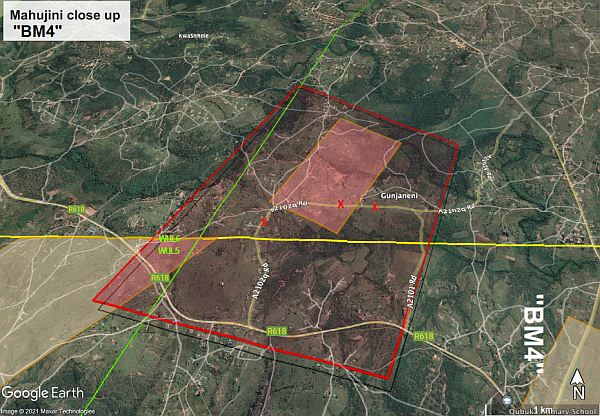
The Applicants’ strongly opposed this approach and argued that Tendele’s invalid mining licence must be set aside, a new mining right applied for to the regional Department of Mineral Resources and the public participation and EIA process must begin. She said “you can’t just leapfrog over the law because you want to start mining in 2022.” It was made clear that if Tendele are allowed to mine in the meantime, there would be no point in doing the public participation, and the entire review application would be a waste of time. Advocate de Vos referred Acting Judge Bam to a Google Earth image of one of the three locations [image below] where the mining pit is depicted in red. She stated: “look at the homesteads around the mining area. There are thousands of people living close to the proposed mine who will be affected. None of these people have been consulted.” This goes for all of the proposed areas and when it comes to the area depicted on the map below, NO-ONE, whether inside or outside the mine area, has been consulted.
Advocate de Vos also told the judge that the manner in which Tendele had conducted themselves during the legal process was despicable and referred to the Rule 7 application papers (available here).
What was not mentioned in Court was the fact that the CEO of Tendele mine had written directly to Gwede Mantashe on 4 October begging him to intervene in the matter “to safeguard the future of the mine”. It’s no wonder that Tendele wants the matter to go back to this same Minister to decide whether the mining right should be allowed to stand or not.
MCEJO – “a big thank you to our lawyers for walking with us on this journey. It was a long one but it resulted in our voices being heard and ultimate victory will be ours.”
Judgement was reserved.
We use cookies to ensure that we give you the best experience on our website. If you continue to use this site we will assume that you are happy with it.