OPEN LETTER: CIVIL SOCIETY ORGANISATIONS CALL ON ATTORNEY, DENNIS SIBUYI AND HIS CLIENTS TO RESPECT THE CONSTITUTIONAL RIGHTS OF COMMUNITY MEMBERS

In an extraordinary show of public solidarity for ALL RISE, 38 civil society organisations have come out in support of an earnest call on the National Union of Mineworkers; Mpukunyoni Traditional Authority; Mpukunyoni Community Mining Forum; the Association of Mineworkers and Construction Union to and their representative attorney to:

• Respect Pretoria high court Judge Noluntu Bam’s 4 May ruling that Tendele Coal Mining’s 2013 application for a mining right (to expand its Somkhele operations) failed to comply with the law; and that the decision of officials in the Dept. of Minerals and Energy to award that right was invalid; 
• Respect the right of the Mpukunyoni people to assert their constitutional rights without fear of reprisal; and
• Respect the right of their attorneys (ALL RISE) to act without fear of harassment, intimidation and defamation.

* Amongst the most serious transgressions was Tendele’s “fundamental breach of the law with regard to public participation”.

The 38 organisations’ letter follows a 17 May 2022 statement titled “Mpukunyoni Community calls on All Rise and their funders to account to the community for their efforts to close Tendele Mine” which attacks All Rise, demanding to know the source of its funding, accusing it of wanting to close the mine and stating that All Rise’s actions are “tantamount to a gross human rights violation”.

Note: ALL RISE Attorneys represent the Mfolozi Community Environmental Justice Organisation, the Global Environmental Trust, Mining Affected Communities United in Action, ActionAid, and the Southern Africa Human Rights Defenders Network.

All Rise is truly humbled by the support and thanks every single organisation that signed this letter. An attack on one is an attack on all. 


SIGNED BY:
Amnesty International South Africa

Bench Marks Foundation

Socio-Economic Rights Institute of South Africa (SERI)

Centre for Applied Legal Studies

Centre for Environmental Rights

Earthlife Africa

Mining Affected Communities United in Action (MACUA) and Women Affected by Mining United
in Action (WAMUA)

Just Share

KZN Violence Monitor

Lawyers for Human Rights

Southern Africa Human Rights Defenders Network (SouthernDefenders)

ActionAid South Africa

Global Witness

Helen Suzman Foundation

Africa Coal Network

Environmental Defender Law Center

Global Environmental Trust

groundWork

350Africa.org

Natural Justice

Health Justice Initiative

BirdLife South Africa

P.E.A.C.E. Foundation Trust

EarthLore Foundation

EMS Foundation

Ian Player Magqubu Ntombela Foundation Trust

Living Limpopo

Animal Law Reform South Africa

Beauty Without Cruelty South Africa

Love Africa Marketing

Rhinos in Africa

Wilderness Leadership School

Future 4 Wildlife

Vervet Monkey Foundation

Global White Lion Protection Trust

Centre for Animal Rehabilitation and Education

The Wildlife and Environment Society of South Africa (WESSA)

We are South Africans

Link to the letter:
https://lnkd.in/d_MPqk2B

Community Rights Vindicated against Unscrupulous Department of Minerals and Energy and “Egregious” Mining Company

Judgment  in the long-standing matter of MCEJO and Others v Minister of Minerals and Energy and Others was handed down on the evening of 4 May 2022. 

In her well-reasoned 48-page judgment Judge Bam finds in favour of the Applicants by rejecting all of Tendele’s arguments and declaring Tendele’s mining right invalid. The Minister’s decision in dismissing the appeal against the grant of the Mining Right and the approval of the Environmental Management Programme is also declared invalid and set aside. The Applicants, the Mfolozi Community Environmental Justice Organisation (MCEJO), the Global Environmental Trust, MACUA, SAHRDN and ActionAid SA, are elated by the victory.

By way of background, in May 2016 Tendele was granted a mining right of 212 km2 to significantly expand its Somkhele opencast coal mine, located in northern KwaZulu-Natal,  subject to approval of an Environmental Management  Programme (EMP). Tendele’s EMP, prepared as part of a Scoping and Environmental Impact  Assessment (EIA) under the Mineral and Petroleum Resources Development Act (MPRDA) was approved several months later in October 2016. The applicants appealed to the Minister of Minerals and  Energy in August 2017 against the Department of Mineral Resources’ (DMR) decision to grant  it. The Minister subsequently dismissed MCEJO’s appeal in June 2018. In November 2018 the applicants brought an application in the Pretoria  High Court to review and set aside the 2016 Mining Right, the approval of the EMP and the  Minister’s appeal decision in Tendele’s favour. 

The Court determined three main issues, namely: i) the defective Scoping and EIA; (ii) the ground based on the Interim Protection of Informal Land Rights Act (IPILRA); and (iii) defects in public participation [para 24] Judge Bam states in her no-holds barred judgment that “the wheels came off” during the scoping phase “when the regional manager of DMR, KwaZulu-Natal (RM), allowed Tendele’s consultants, GCS, to dictate to him how Tendele intended to carry out the exercise that would lead to the Scoping Report instead of insisting on compliance with the law” [para 14] She further states that “[i]ndeed the record shows that the RM accepted Tendele’s Scoping Report, even though it had been compiled without consultation with interested and affected parties and without providing proof of the information shared during the consultation, which was clearly in violation of the law”. [1]

Judge Bam provides detailed interpretation of the law around scoping and EIA and refers to Tendele’s view that the scoping phase required no public participation as “a fundamental breach of the law with regard to public participation”. She further states that “Tendele’s attempts to justify their exclusion of groups … was nothing short of egregious”. The Scoping/EIA failed to meet the demands of legislation. She states that “[t]he attitude displayed by Tendele during the scoping phase of it’s application process is offensive. It portrays Tendele as an ‘unbridled horse’ that showed little or no regard for the law” [2]

A large portion of the judgment deals with the applicants’ accusation of Tendele riding roughshod on the rights of the community in that the applicants’ members were neither consulted nor did they consent to the deprivation of their communal rights to the land in terms of IPILRA. 3  [para 39] The Court refers to Tendele’s ‘disturbing’ defence that ‘since the grant of a mining right does not extinguish the right of a landowner or any other occupier of the land in question; the question of compensation does not arise”. [3] According to Tendele’s interpretation of IPILRA the requirements of compensation and section 2(4) (community consent) are only triggered when the deprivation is caused by a disposal of land. [4]

Judge Bam finds that “Tendele’s interpretation appears to lose sight of the fact that it is interference with the use, enjoyment or exploitation or diminution to the occupation or ownership that brings about compensation. For this reason, how the deprivation arises should not water down the compensation element provided for in IPILRA. Tendele’s interpretation epitomizes the ‘blinkered peering at an isolated provision in a statute’ that the court warns against in Scribante as opposed to reading the statute purposively… Tendele’s’ interpretation waters down, if not renders nugatory, the protection offered by IPILRA to shield the informal rights holders. Such interpretation cannot be allowed”. [5]

Tendele’s second defence that it obtained consent from the Inkosi, is also shot down in flames by Judge Bam. The referenced consultations with iziNdunas who provided consent by way of a Resolution of the Traditional Authority “says nothing more that the [traditional authority] granted consent to Tendele. There is no evidence to support that the applicants were lawfully deprived of their informal rights in terms of IPILRA. There is no evidence of invitation to the community and its representatives, no agenda, no minutes, no evidence of who was present. The Resolution on its own does not meet the requirements of IPILRA”. [6]

Judge Bam’s final reason why Tendele’s defence must fail is centered around the fact that a decision to grant consent to a mine “has far reaching consequence in so far as the mining operations ability to interfere with the occupiers’ and landowners’ rights.” [7] With reference to the court in The Ingonyama Trust and Advancement of the South African Constitution and Others v The Ingonyama Trust and Others, Judge quotes:

“Consent must be given freely, without duress or deception, and with sufficient legal competence to give it….Consent must be properly sought and freely given, and the person whose consent is required must have full and reliable information relating to the scope and impact of the subject matter, and must have the choice to give or withhold his or her consent.”

“In all, Tendele did not obtain consent as envisaged in section 2 of IPILRA and the applicants ground therefore succeeds”.[8]

The appeal is therefore remitted back to the Minister for reconsideration in accordance with the findings of the judgment. [9]

In summary, the findings and the effects thereof are:

  1. The Scoping/EIA was unlawful. Prior to the Minister making a decision on the Appeal, a valid Scoping/EIA must be conducted.
  2. There was no consent in terms of IPILRA. Prior to the Minister making a decision on the Appeal, informed consent must be obtained from the majority of those whose land rights will be affected by the mining operation.
  3. The public participation process was defective. Prior to the Minister making a decision on the Appeal, a full public participation process must be conducted, and such process must comply with the requirements of the Public Participation Guidelines in terms of the National Environmental Management Act, 1998 and Chapter 6 of the Environmental Impact Assessment Regulations, 2014.

Costs were awarded to the applicants, including the costs of two counsel for this application and the Rule 7 application which was brought by Tendele in December 2020 and withdrawn at the 11th hour in March 2021.

“Tendele is the author of its own misfortune. “Had DMR and Tendele complied with the law back in 2013 when this mining application process began, none of this would have been necessary. The Court has made it clear that the people of the land must be seen, must be heard, and must be consulted when their rights are going to be so fundamentally affected. The fact that the DMR and Tendele ignored the law and the people for so long is the reason that the applicants were forced to bring this application. It has been a long road but finally they have won.” Kirsten Youens, attorney for the Applicants.

The applicants wish to thank Legal Aid SA for its assistance in this matter.

References to paragraphs in judgment:

  1.  [para 14]
  2.  [para 37]
  3.  [para 51]
  4.  [para51]
  5.  [para 56] 
  6.  [para 66]
  7.  [para 67]
  8.  [para 70]
  9. [para 84.3]

Unfortunate Environmental Authorisation Precedent Stands as Application to the Constitutional Court Dismissed

Unfortunate Environmental Authorisation Precedent Stands in the matter between the Global Environmental Trust & MCJEJO v Tendele Coal Mining (Pty) Ltd and Others as Application to the Constitutional Court Dismissed

By Kirsten Youens

On 11 January 2022 the long awaited decision by the Constitutional Court regarding our application for leave to appeal filed in April 2021 was received. Disappointingly, it was dismissed which means that this important legal issue will not be argued in South Africa’s highest court.

The background to this matter between our clients (the Global Environmental Trust and the Mfolozi Community Environmental Justice Organisation) and Tendele Coal Mining (Pty) Ltd revolved around the interpretation of the Mineral and Petroleum Resources Development Act 28 of 2002 (MPRDA) and the National Environmental Management Act 107 of 1998 (NEMA) before the “One Environmental System” came into force on 8 December 2014. In short, the issue was whether the environmental impact of mining operations was exclusively dealt with under the MPRDA through approval of the Environmental Management Programme (EMP), or whether an environmental authorisation issued under NEMA was also required before mining operations could commence.

Tendele has neither applied for nor been granted environmental authorisation under NEMA for its open cast coal mine in northern KwaZulu-Natal, but held the view that its EMPs prepared and approved in terms of the MPRDA were sufficient. Our clients demanded Tendele seek an environmental authorisation under the NEMA. Tendele’s argument was that no environmental authorisation was required for mining rights sought before December 2014. 

We applied for an interim interdict to stop Tendele from mining until it obtained environmental authorisation. The Pietermaritzburg High Court sided with Tendele. After criticising the applicants’ pleadings, the court found that mining rights sought before December 2014 do not require environmental authorisation. According to the High Court, the MPRDA covered all environmental impacts of mining and NEMA had no role even with regard to the ancillary activities related to mining that were listed in the NEMA Environmental Impact Assessment regulations. The High Court also ordered costs against the applicants with no reference to the principles of Biowatch (ie. persons should not be deterred from enforcing their rights in fear that they will have to pay their opponent’s costs if they do not succeed). This principle arose from the Constitutional Court case of Biowatch Trust v Registrar Genetic Resources and Others. 

Given that a judgment stands until either rescinded or set aside by a court of appeal, our clients appealed this judgment to the Supreme Court of Appeals (SCA). 

The majority judgment handed down by the Supreme Court of Appeal dismissed the appeal on the basis of its pleadings. It criticised the applicants for not enumerating which specific listed activities Tendele undertook that obliged it to seek an environmental authorisation under NEMA. The majority judgment however did not address the legal issue of the requirement for environmental authorisation under NEMA nor the issue of the costs order.  

However, one of the judges, Schippers JA, was not persuaded by Tendele’s “quibbles” about our pleadings in his dissenting judgment. He called them ‘opportunistic and contrived’. Schippers JA accepted our argument that there was no genuine dispute over whether Tendele is conducting listed activities. Tendele is mining ‘one of the largest resources of open-pit mineable anthracite reserves in South Africa’ and it therefore must be conducting listed activities. Also, Tendele never denied that its ‘mining operations triggered any listed activity.’ 

Schippers JA’ dissenting judgment would have interdicted Tendele from mining without an environmental authorisation and ordered Tendele to pay costs. Boosted by this dissenting judgment, in April 2021 we sought the Constitutional Court’s leave to appeal  the majority judgment of the Supreme Court of Appeal. 

On 11 January 2022 we received notice that the Constitutional Court had dismissed our application. Therefore, the law right now is as pronounced by the High Court – that environmental authorisation is not required where a mining right was applied for before December 2014. The precedent of the High Court’s costs order against the community organisation and the chilling effect it has on constitutional litigation against mining companies, also still stands. 

The law around environmental authorisations for activities related to mining prior to December 2014, therefore remains murky. 

In the Mabola Case, the Court was faced with an application to review and set aside a decision to permit coal mining activities in a protected wetlands area.  Judge Davis held that the party seeking to conduct such mining activities would be required to obtain five different authorisations, including the approval of its EMP in terms of section 39 of the MPRDA and environmental authorisation for listed activities in terms of section 24 of NEMA. 

The Court in the Mineral Sands Resources case adopted the same view, albeit obiter, with Judge Rogers finding that prior to 8 December 2014 the decision to approve an applicant’s mining EMP and to grant the mining licence effectively constituted the environmental authorisation to conduct the mining activity but at the same time, the applicant would also have needed to obtain a NEMA environmental authorisation.

Recently, in case of Sustaining the Wild Coast NPC and Others against Shell’s seismic survey being undertaken on the Wild Coast, in which ALL RISE, NPC was an applicant, Judge Bloem held in his judgment:

Whether or not Shell requires an environmental authorisation obtained under NEMA is a difficult legal issue. The Minister caused an affidavit to be delivered wherein he adopted the stance that “the environmental management programme used to support the application made by [Impact Africa} for the renewal of its exploration right…constitutes an environmental authorisation, as envisaged by the National Environmental Management Act 107 of 1998 (NEMA)”. Whether this is so, however, is a decision to be made by the court. Although I am of the view that the applicants have prospects of success in that regard, it is a matter that should rather be considered by the court which will determine the relief south under Part B of the notice of motion. 

Thus, it is unfortunate that in our Global Environmental Trust matter the majority of the SCA did not deal with the environmental authorisation issues. However, as mentioned above, Schippers JA dealt squarely with the fact that a separate environmental authorisation under the NEMA was required:

It is clear, simply from the above provisions of NEMA, that an environmental authorisation granted by a competent authority under NEMA is not the same thing as an EM approved under the MPRDA. In Minister of Mineral Resources v Stern (to which we were not referred), this court assumed, without deciding, that an environmental authorisation under NEMA is essentially the same as an EMP. In my view, it is not. An environmental authorisation is required for the commencement of an activity identified in a listing notice. The impacts of listed activities on the environment are assessed in order ‘to give effect to the general objectives of integrated environmental management’ in Chapter 5 of NEMA, which lays down rigorous processes for that assessment.

We agree that it is clear. Section 5A of the MPRDA provides that no person may prospect for or remove, mine, conduct technical co-operation operations, reconnaissance operations, explore for and produce any mineral or petroleum or commence with any work incidental thereto on any area without an environmental authorisation. Section 24F of NEMA prohibits the commencement of any listed activity without an environmental authorisation. What were two parallel processes prior to 2014 – one being the environmental authorisation process under NEMA and the other being the EMPr under the MPRDA – became ONE process with the introduction of what is aptly referred to as the One Environmental Management System on 8 December 2014. Conducting mining activities authorised prior to 8 December 2014 in the absence of an environmental authorisation issued in terms of section 24 of NEMA are unlawful. Unfortunately, the Constitutional Court will not be deciding the issue and legal certainty is still needed.

REVIEW HEARING HEARD 10-12 NOVEMBER IN THE PRETORIA HIGH COURT – SOME FEEDBACK

The court hearing for the review of Tendele’s vast 2016 mining right was from the 10 – 12 November 2021. The hearing of the case went well, with the Applicants’ advocate, the formidable Anna-Marie de Vos  presenting a clear and compelling argument. Acting Judge Bam was clearly well prepared and concerned about the impact of mining on the community and the lack of community consultation and consent. Tendele’s advocates conceded that the mining licence was unlawful, but that if Tendele was not able to expand into the area under review, the mine would close and the people would lose their jobs. Although Tendele conceded that its public participation process was flawed and its mining right was granted unlawfully, Tendele stated its intention to mine in three locations, namely Mahujini, Malahleni and Ophondweni. 

Tendele proposed that it does a public participation process in terms of the EIA regulations (to include all the 27 new specialist studies concluded last year) while the matter  goes back one step to the administrative appeal stage. In other words, it will be referred back to Gwede Mantashe, the Minister of Mineral Resources, to decide on the appeal again. (Please bear in mind that it was Gwede Mantashe who refused the Applicants’ appeal in 2018 which resulted in the court application being launched in the first place). Even more astoundingly, Tendele intends to mine Malahleni and Ophondweni in the meantime.

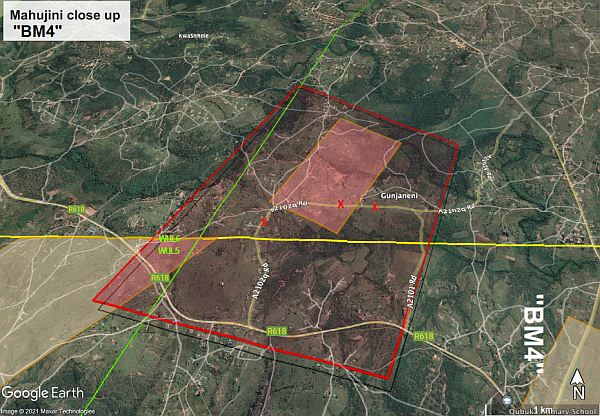
The Applicants’ strongly opposed this approach and argued that Tendele’s invalid mining licence must be set aside, a new mining right applied for to the regional Department of Mineral Resources and the public participation and EIA process must begin. She said “you can’t just leapfrog over the law because you want to start mining in 2022.” It was made clear that if Tendele are allowed to mine in the meantime, there would be no point in doing the public participation, and the entire review application would be a waste of time. Advocate de Vos referred Acting Judge Bam to a Google Earth image of one of the three locations [image below] where the mining pit is depicted in red. She stated: “look at the homesteads around the mining area. There are thousands of people living close to the proposed mine who will be affected. None of these people have been consulted.” This goes for all of the proposed areas and when it comes to the area depicted on the map below, NO-ONE, whether inside or outside the mine area, has been consulted. 

Advocate de Vos also told the judge that the manner in which Tendele had conducted themselves during the legal process was despicable and referred to the Rule 7 application papers (available here).

What was not mentioned in Court was the fact that the CEO of Tendele mine had written directly to Gwede Mantashe on 4 October begging him to intervene in the matter to safeguard the future of the mine. It’s no wonder that Tendele wants the matter to go back to this same Minister to decide whether the mining right should be allowed to stand or not.

MCEJO – “a big thank you to our lawyers for walking with us on this journey. It was a long one but it resulted in our voices being heard and ultimate victory will be ours.”

Judgement was reserved.

Appeal of Water Use Licence – Tendele Coal Mine

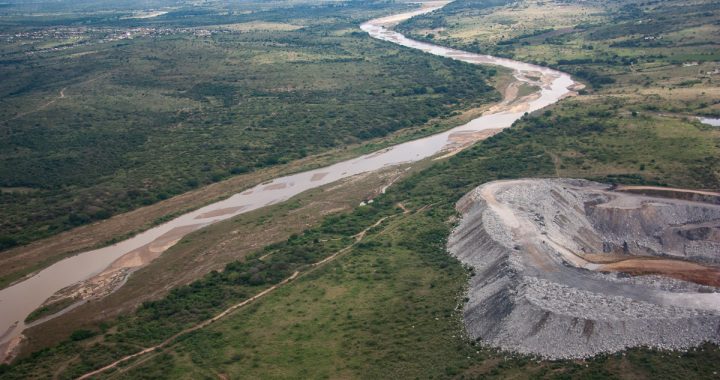
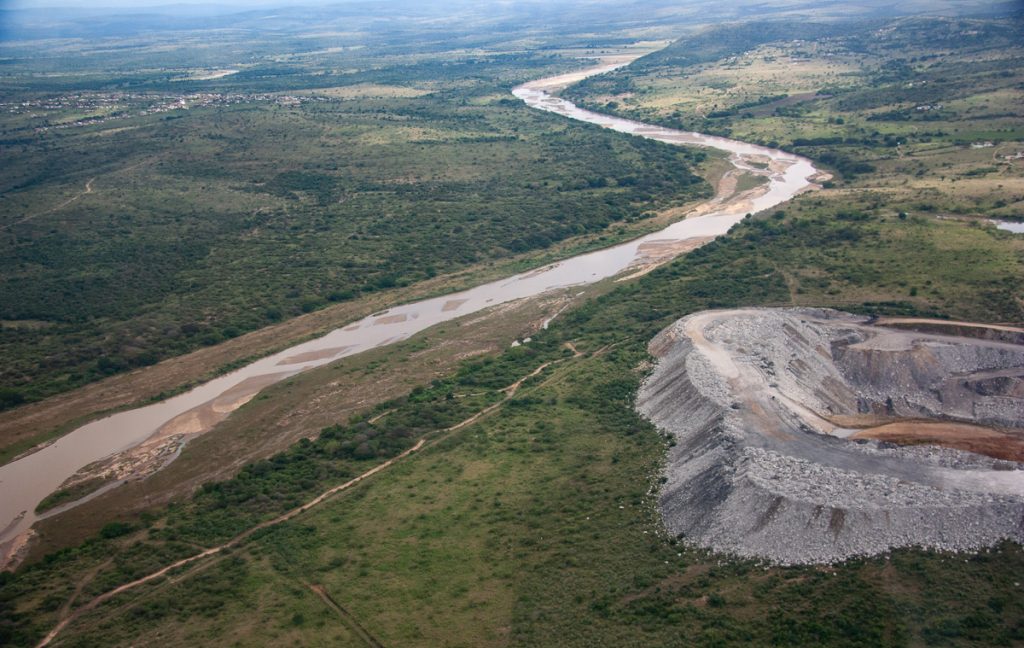
Tendele Mine on the banks of the Mfolozi River – photo by Rob Symons

Last week brought another challenge to Tendele Mining (Pty) Ltd, a subsidiary of Petmin, with an appeal being lodged against its water use licence issued by the Acting Director-General of the Department of Water and Sanitation. 

The appeal was lodged by ALL RISE Attorneys for Climate and Environmental Justice on behalf of the Mfolozi Environmental Community Justice Organisation, MCEJO and the Global Environmental Trust. 

Both these organisations are applicants with MACUA, SAHRDN and ActionAid SA in a court application challenging the validity of Tendele’s mining right granted in 2016 which allows the mine to significantly expand its operations into new areas. The matter is being heard virtually this week on the 10th to 12th of November by the Pretoria High Court.

Asked why the water use licence is being challenged, Janice Tooley, attorney and director at ALL RISE said that it was for multiple reasons which are set out in detail in the appeal. One of the main reasons is that Tendele and its consultants GCS had failed to consult with the very people who will adversely be affected from mining operations and the associated 142 water uses that have been approved, including the permanent destruction of streams and wetlands and possible pollution of surface and groundwater.

Many of the local residents in these rural communities are subsistence farmers, and without an adequate supply of clean water, they are unable to grow food and water their livestock. For years, many of their streams and boreholes have run dry and the rainwater they collect from the roofs of their houses has been contaminated by coal dust making it unfit for drinking, forcing people to have to buy water at great expense.   

She said that it was wrong for the Department to have accepted Tendele’s water use licence application to start with because Tendele does not have the necessary landowner consent from the community, which is a legal requirement. 

All Rise also obtained expert advice from an independent water expert, who reviewed the technical reports and found them to contain significant gaps, incorrect assumptions and insufficient mitigation measures to protect the water resources and downstream users. 

Our government acting through the Minister of Water and Sanitation is the public trustee of our nation’s water resources and is responsible for ensuring that water is protected and used in an equitable and sustainable manner for the benefit of all persons. By issuing the water use licence to Tendele without proper procedure having been followed, and in the absence of comprehensive technical information, government has not upheld its constitutional mandate. Simply put, the water use licence should not have been issued.

Appeals against water use licences are currently heard by the Water Tribunal, an independent body specifically established to hear appeals against directives and decisions made by water authorities in terms of the National Water Act. This is not a quick process and in terms of the Act, Tendele’s water use licence is automatically suspended until the appeal has been decided, unless directed otherwise by the Minister. 

Download links below:

NOTICE OF APPEAL IN TERMS OF SECTION 148(1) OF THE  NATIONAL WATER ACT, 1998 (ACT NO.36 OF 1998)

ALL APPEAL DOCUMENTS

Dates confirmed for Review Application

Good news: Deputy Judge President Ledwaba has confirmed that our Review application will be heard on 10, 11 and 12 NOVEMBER 2021. Parties are working hard at trying to limit the issues in dispute (which will also limit the reading of the 8000 page record) and have been instructed to file a revised Joint Practice Note by 5 November.

Nearly three years after the application was first instituted in the Pretoria High Court to review and set aside Tendele’s Mining Right, and several postponements later, the court hearing set down for 6 and 7 October had again been postponed.

The court application was brought by the Mfolozi Community Environmental Justice Organisation (MCEJO) and four co-applicants, GET, MACUA, SAHRDN and ActionAid SA against the decision made in 2016 granting Tendele Coal Mining (Pty) Ltd a new mining right in Somkhele, an area falling between Mtubatuba and Hluhluwe-iMfolozi Park, in north-eastern KwaZulu-Natal. This mining right allows Tendele to significantly extend its mining operations into three new areas displacing thousands more people in addition to those already affected by its existing mining operations that commenced in 2007.

Please read:

Somkhele project fact sheet

Previous post “ANOTHER DELAY TO MCEJO’S COURT CHALLENGE OF TENDELE’S SOMKHELE MINING RIGHT”

Daily Maverick article by Tony Carnie (7 October 2021)

South African government urged to take bold steps to empower our Constitutional Rights to a healthy environment

Photo by Lihle Mbokazi

JOINT PRESS RELEASE: 25 October 2021
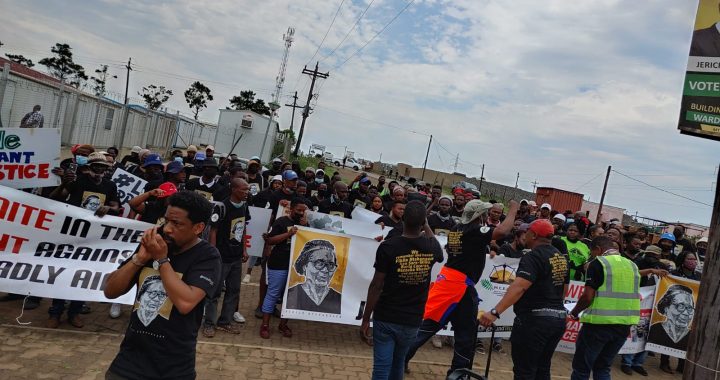
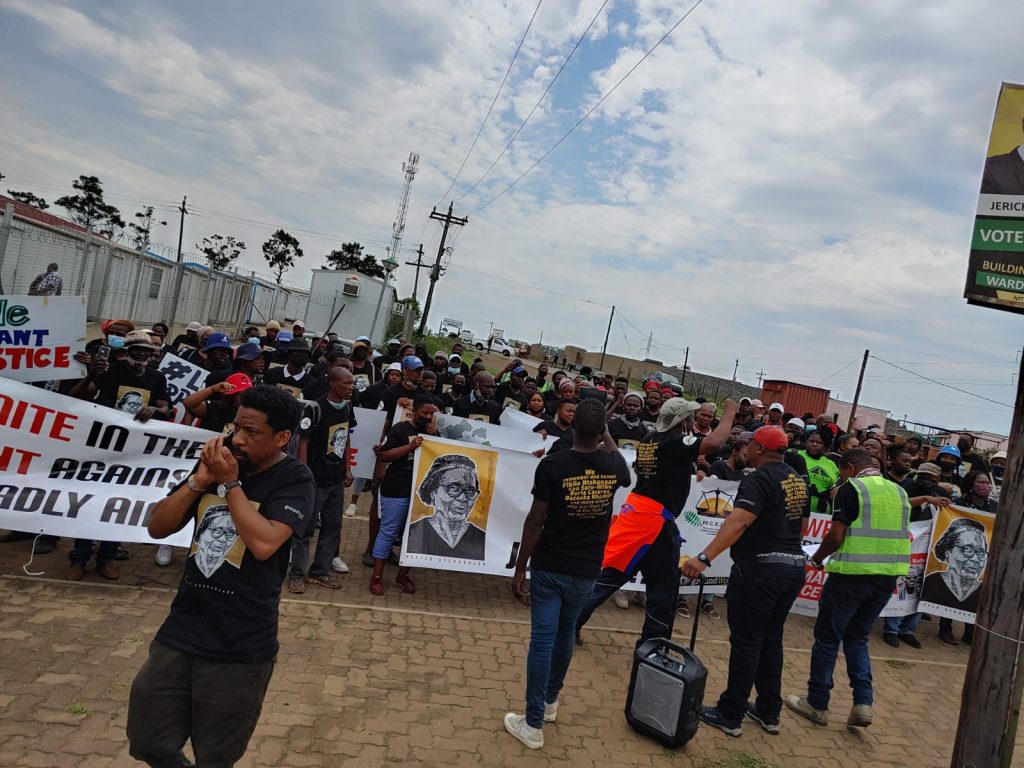
On Friday, 22 October, in remembrance and support of environmental activist and campaigner, Fikile Ntshangase, a group consisting of environmental justice activists, NGOs and community members, from the area surrounding a controversial coal mine, marched on the anniversary of her murder. The march was in support of the #DefendTheDefenders and #JusticeForFikile movement.

On that day one year ago, Fikile Ntshangase, was assassinated in her home in Northern KwaZulu-Natal by three unknown people. No arrests have been made to date. Fikile was a prominent member of the Mfolozi Community Environmental Justice Organization (MCEJO), who are currently opposing the extension of Tendele Coal mine in KwaZulu-Natal.

“We won’t solve the climate crisis without protecting the defenders – and we can’t protect the defenders if murders go unpunished. Accountability for those who ordered this killing won’t bring justice for Fikile or her family, but it would go some way to preventing further violence against protectors of the earth, and therefore to preventing climate breakdown.” Kirsten Youens, Attorney and Executive Director at ALL RISE, attorneys for climate and environmental justice.

This day saw the call by climate change NGO’s who are urging the South African Government to commit to protecting those who are exercising their constitutional right to a healthy environment.
This would include:

  1. Providing adequate policing and security for those at risk.
  2. Respecting and prioritising the principle of free, prior and informed consent in all community land rights issues.
  3. Ending South Africa’s economic reliance on coal mining.
  4. Ensuring that those responsible for the murder of Fikile Ntshangase are brought to justice and held accountable.
  5. Taking bold actions to give prompt and real effect to our constitutional right to a healthy environment.


While this talks to South Africa, the problem is a global one. Last year, Fikile was one of 227 people around the world who lost their lives in 2020 defending their homes, their land and livelihoods, and the ecosystems we all depend on.

“The structure of the economic model inherited from the colonial system of extractivism especially in mining is increasingly bringing to the fore the role of business in human rights violations and the increasing threats to Human Rights Defenders working on land, environment and indigenous communities. The heavy reliance on fossil fuels brings the dilemma posed by the mining/energy matrix that translates into tremendous pressure on our environment and our climate as well as on land, environmental and indigenous defenders. We predict escalation in Southern Africa.” Arnold Tsunga – Chairperson for Southern Africa Human Rights Defenders Network.

In a live webinar discussion on Friday, hosted in support of #DefendtheDefenders, one of the panelists, Dr Rowan Williams, former Archbishop of Canterbury commented, “The climate crisis is not just one problem. We are dealing with a host of moral crises. If we cannot learn to treat our environment ethically, we cannot treat one another ethically.”

Please join the movement in celebrating the lives of defenders like Fikile and demanding justice on the hashtag: #DefendtheDefenders & #JusticeforFikile.


ENDS

Joint Press release by:

  • All Rise – Attorneys for Climate and Environmental Justice
  • Global Witness
  • MCEJO – (Mfolozi Community Environmental Justice Organisation)
  • Global Environmental Trust
  • Environmental Defender Law Center
  • groundWork
  • Southern Africa Human Rights Defenders Network

Press Release: 18 October 2021

Call for justice for environmental defender – Fikile Ntshangase – a year after her murder in South Africa.

On October 22nd last year, Fikile Ntshangase was at home with her grandson Buyile in Ophondweni, Kwazulu-Natal province, South Africa. Three unknown men arrived and shot her dead in her living room.

Fikile was a mother and grandmother, a campaigner, and a leader, who had been opposing the extension of Tendele Coal mine in Northern KZN. Friday the 22nd will mark one year since her brazen and brutal assassination. No arrests have been made.

“We will always remember Fikile courageously standing up against Tendele coal mine’s expansion and voicing the truth. She is gone but her legacy and fight continue.” Kirsten Youens, Attorney, Executive Director, ALL RISE.  

We are in the midst of a climate crisis. The South African government has a duty to protect environmental defenders and the crucial work they do in protecting the natural world. Disturbingly, they’ve been silent on Fikile Ntshangase’s murder and the daily dangers faced by other defenders.

The problem extends far beyond South Africa. Last year, Fikile was one of 227 people around the world who lost their lives in 2020 defending their homes, their land and livelihoods, and the ecosystems we all depend on. Environmental defenders have the right to be protected, the right to protest  and the right to justice and accountability. Yet we see time and time again that their rights are ignored in favour of corporate interests and industry.

On Friday October 22nd , and Saturday October 23rd, colleagues and members of the public will join Fikile’s family and the Mfolozi Community Environmental Justice Organisation (the community organization that Fikile was part of), in a day of action and a day of remembrance. 

“This week takes me back to a time that I would give anything to forget. I miss my mom, my hero and my rock. I pray for justice and peace. I pray for her legacy to live on and that her spirit awakes in us all!” Malungelo Xhakaza, daughter of Fikile Ntshangase. 

All Rise and their partners urge South Africa’s parliament and government take active steps to investigate the unsolved murders of Fikile and others who lost their lives – and that other governments across the globe follow suit.

Please join the movement and the march this week in celebrating the lives of defenders like Fikile and demanding justice on the hashtag: #DefendtheDefenders & #JusticeforFikile. 

To join the march, visit this link for more information: https://allrise.org.za/we-demand-justice/ 

Please find photography, graphics and information on Fikile at the links below:

ENDS:

More information: 

ALL RISE is a non-profit company, public benefit organisation and registered law clinic with an all women board of directors (executive and non-executive). We are the only pro bono attorneys in KwaZulu-Natal, South Africa, working exclusively in the environmental field and one of a few in the country. We assist communities and organisations to assert their Constitutional right to an environment that is not harmful to their health or well-being. https://allrise.org.za/

Global Witness works to hold companies and governments to account for their destruction of the environment, their disregard for the planet and their failure to protect human rights.  https://www.globalwitness.org/en/

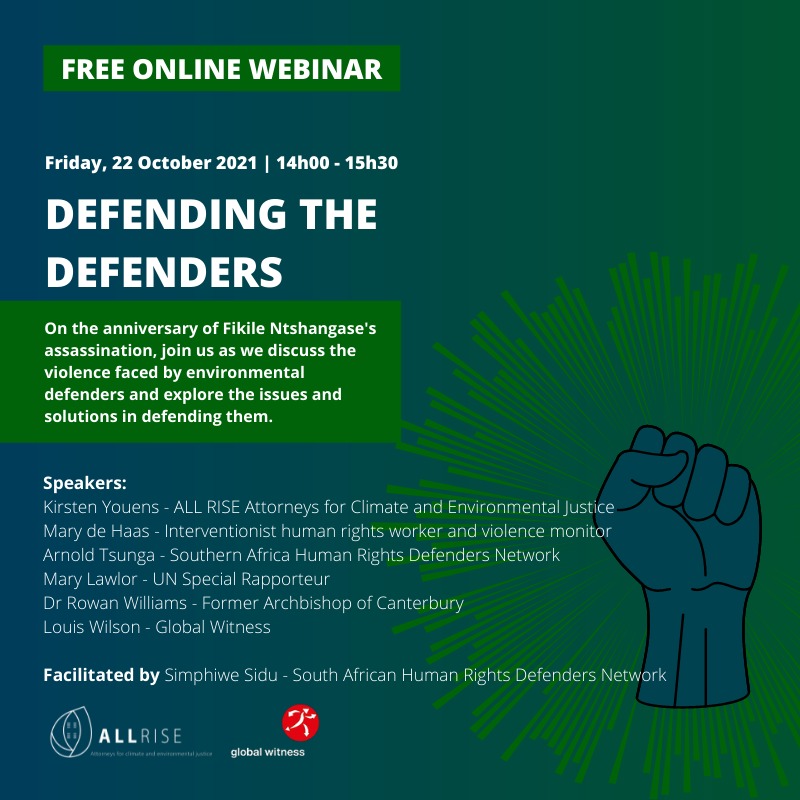
Defending the Defenders

This Friday, the 22nd October 2021, is one year after environmental defender, Fikile Ntshangase was murdered in her home.

Join the webinar on the 22nd October 2pm (GMT +2) with Kirsten Youens, Arnold Tsunga, Mary de Haas, Louis Wilson, Mary Lawlor and Rowan Williams as they discuss local and global issues and how to defend the defenders. Facilitated by Simphiwe Sidu.
Register for the webinar here. https://zoom.us/webinar/register/WN_pgVx5SuzQFmxso6vcuYe-A

Unforgettable Fikile

Fikile Ntshangase – photo by Rob Symons

By Sheila Berry

Mam Fikile Ntshangase was a shero who paid with her life for her strong belief in justice and integrity. It took 6 bullets from a hired assassin’s gun to silence this 63-year-old woman who unflinchingly spoke out against corruption, illegal actions and acts of betrayal. 

Fikile’s name means “arrived” in Zulu and sums her up very well. When she arrived at meetings her presence was manifest. She dressed elegantly and sat in the front rows. She engaged actively in what was being presented and was not afraid to express what was on her mind.  She was meticulous about gathering information and armed with the facts, she was fearless in speaking truth to power. She challenged ministers, high-ranking officials, and traditional leaders and would call them to account. 

Fikile’s activism started in high school, where she was involved in community service to counter the injustices and inequality of the apartheid regime. 

As a young woman, she was active in politics but unencumbered by party politics. She aligned herself with those who shared her views and values more than with a political party, especially one that was failing the very people it was created to serve.  Her objective was to change the repressive and unjust society she grew up in and not about seeking personal power.  She wanted people to experience freedom and justice, and to know their rights and fight for them, especially their constitutional and land rights. She even named her daughter Malungelo, which means “rights” in Zulu.  

Things also had to be done right.  Fikile spoke out strongly when things were done in an unacceptable way or did not follow the required protocols. She was relentless when she came across an irregularity and would raise the issue at every opportunity until she was heard. She saw it as her civic duty to expose what was wrong and unacceptable, and to educate people about the right way to do things.  She had been a teacher and would not accept the idea that if you lived in a rural community you were uninformed. 

Fikile valued and appreciated herself as a woman and encouraged young women to respect themselves and be aware of the important contribution women made to the world. She was a mother, grandmother, and a pillar of the Ophondweni community. Her home was always open. She never turned anyone away who came to her in need. She was also a loving wife and enjoyed a very happy marriage with her late husband who fully supported and respected her and her work. 

The Global Environmental Trust and All Rise are honoured to have worked closely with Mam Fikile and support all efforts to share her rich and instructive story. As a committed teacher, Fikile would have appreciated any helpful learnings that emerge from her life …. and her death. 

This article was also published in saveourwilderness.org